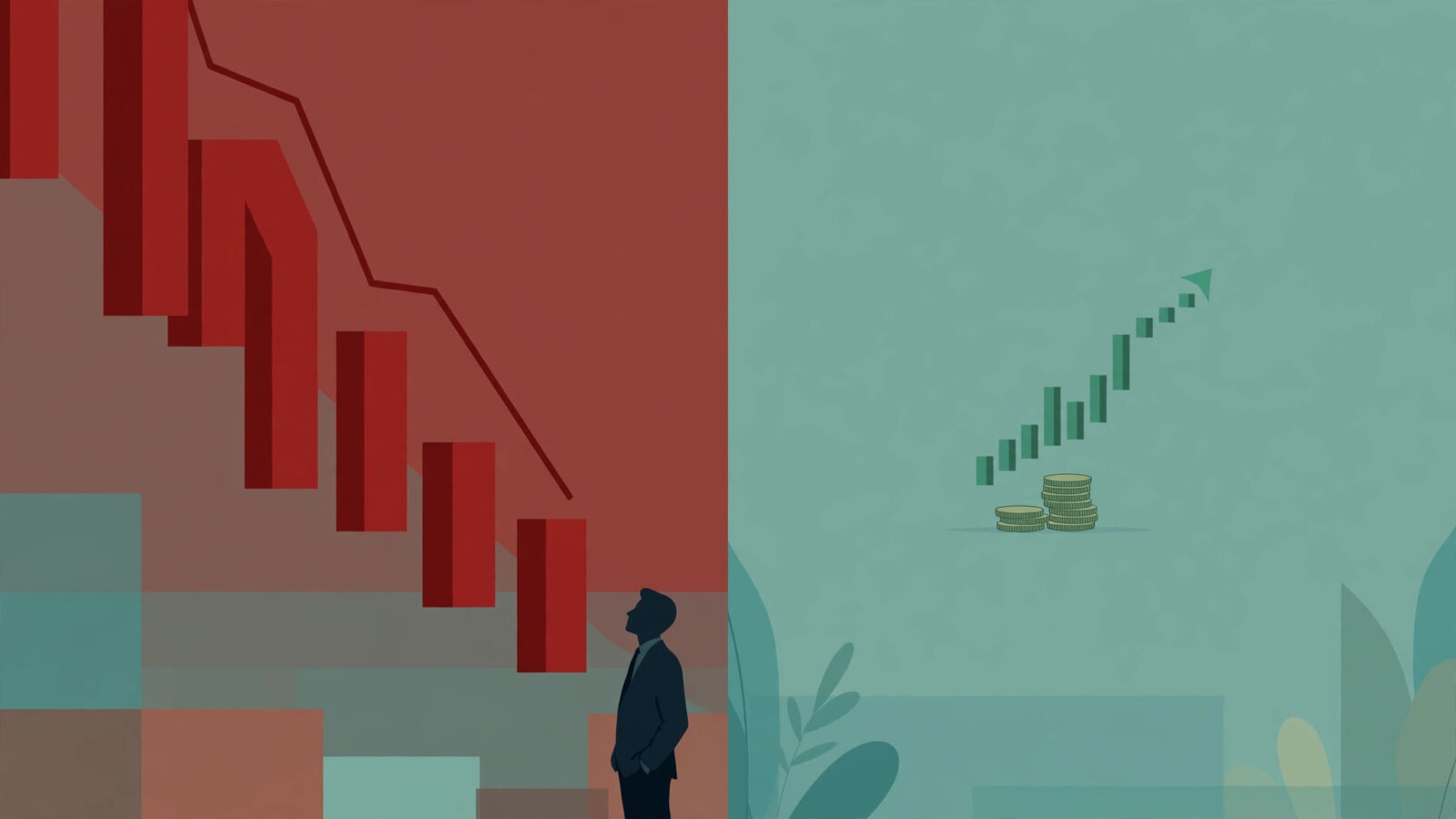
Check your portfolio on a red week and something strange happens to the arithmetic. A $500 gain last month registered as a pleasant moment, gone by lunch. A $500 loss this week follows you to bed. Same dollars. Completely different weight.
That asymmetry is not a character flaw, and it is not just you. It is one of the most replicated findings in the psychology of decision-making — and once you see it, you start seeing it everywhere your money moves.
The experiment that broke the old model
In 1979, psychologists Daniel Kahneman and Amos Tversky published Prospect Theory, the work that quietly dismantled the idea that humans weigh gains and losses rationally. Offered simple gambles, people consistently refused bets that a purely rational calculator would take — not because they misunderstood the math, but because the pain side of the scale is heavier than the pleasure side.
In their later measurements, the ratio came out at roughly two to one: a loss hurts about twice as much as an equal-sized gain feels good. Lose $100 and it stings like finding $200 would delight you. Economists call it loss aversion, and the “twice as big” in this headline is not a metaphor. It is close to the measured coefficient.
Why your brain is wired this way
For most of human history, the asymmetry was good engineering. A windfall — extra food, extra resources — improved your situation. A loss of the same size could end it. The ancestors who treated losses as emergencies out-survived the ones who shrugged at them, and their caution is installed in you by default.
The problem is the environment changed faster than the wiring. Your portfolio is not a winter food store. A 10% drawdown in an index fund is not a famine. But the alarm system cannot tell the difference, so it responds to a red chart with the emotional urgency of a physical threat — and urgency is a terrible portfolio manager.
What it does to your decisions
Loss aversion does not just make losses feel bad. It bends behavior in predictable, expensive directions:
You sell your winners too early and ride your losers too long. This is the disposition effect, documented in real brokerage records. In a landmark study of 10,000 accounts, Terrance Odean found investors were far more willing to sell positions that had gone up than positions that had gone down — because selling a loser makes the loss “real,” and the brain will pay to postpone that pain. The punchline: the winners those investors sold went on to outperform the losers they kept by about 3.4 percentage points over the following year. The feeling protected itself. The portfolio paid for it.
You check too often, and it changes what you do. Economists Shlomo Benartzi and Richard Thaler showed that loss aversion gets more powerful the more frequently you look — they called it myopic loss aversion. A portfolio checked yearly shows mostly gains. The same portfolio checked daily shows a coin-flip of red and green days, and each red one lands twice as hard. Frequent checking does not make you better informed. It makes the pain arrive more often, and pain demands action.
You feel this week more than the last five years. A brutal week — the kind crypto and stock investors have had recently — can emotionally erase years of compounding, because the recent loss is vivid and the old gains have faded into the background of “normal.” The account balance knows the truth. The feeling does not.
Working with the wiring instead of against it
You cannot uninstall loss aversion, and you would not want to — it is the same circuitry that keeps you from genuinely reckless bets. The goal is to stop it from silently making your decisions:
- Decide your sell rules while you are calm. Write down, in advance, what would make you sell each position — a thesis breaking, a target reached, a date. In a panic, you will not invent good rules. You can only follow ones you already made.
- Check less often than feels responsible. Weekly or monthly reviews show you the same portfolio with a fraction of the pain samples. Most “urgent” portfolio feelings expire before the next scheduled look.
- Look at percentages of the whole plan, not dollars of the day. A $2,000 red day inside a $200,000 long-term plan is a 1% wobble. The dollar figure triggers the alarm; the percentage tells the truth.
- Name the feeling when it shows up. “This is loss aversion, not information” sounds simple, but labeling an emotion measurably reduces its grip. The loss is real. The urge to act right now is the wiring, not the analysis.
The honest summary
Losing feels twice as big as winning because, for the world your brain was built in, it was. The modern investor’s job is not to feel less — it is to notice when an ancient alarm is dressed up as a financial insight, and to let the plan, written in a calm moment, outrank the feeling of a red day.
Your portfolio will have more red weeks. The question loss aversion asks is whether each one gets to make decisions your calm self never approved.
Try it on yourself: would you rather lose $100 for certain, or flip a coin between losing $250 and losing nothing? Most people take the gamble to avoid the sure loss — and take the sure $100 over the identical gamble when it is framed as a gain. Same math, opposite choices. That gap is the whole story. Cast your vote in today’s poll at Normie and see how thousands of others answered.
Decide calm, in writing
The first piece of advice above — write your rules down while you are calm — is easier with a worksheet than a blank page. The Crypto Rich Interactive Workbook is free, and it walks you through position sizing, entry and exit rules, and review habits built for exactly the moments this article describes: free on Gumroad. The full Crypto Rich Guide & Workbook bundle ($47) adds the complete research framework behind it: get the bundle.