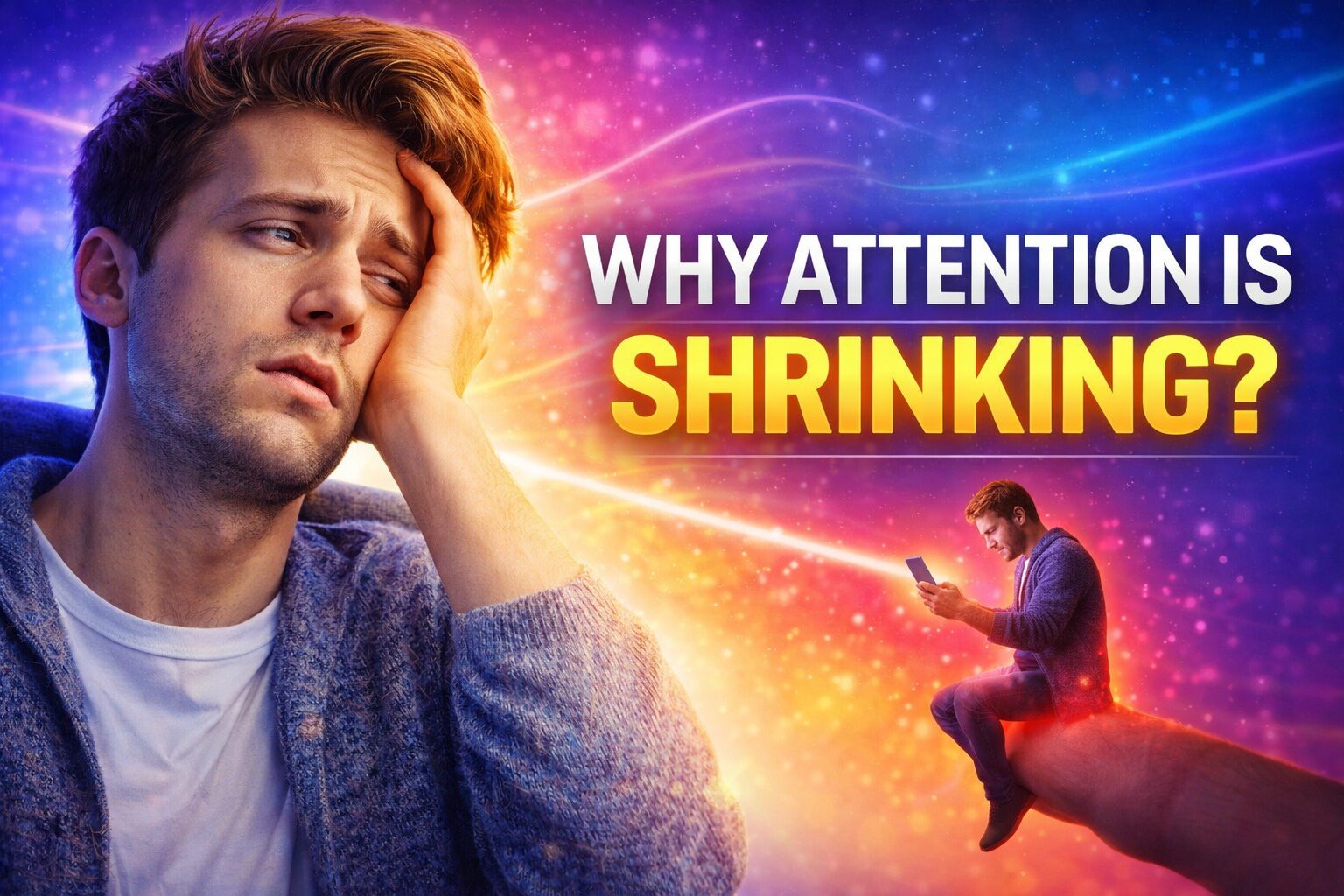
An old idea about a modern problem
In 1971, the economist and psychologist Herbert Simon wrote a chapter on how organizations should cope with a surplus of information. His point was practical. Information is not free to receive, because receiving it uses up the time and focus of the person on the other end. From that he drew a conclusion that later writers took up when they talked about an “attention economy”.
A wealth of information creates a poverty of attention.
Herbert A. Simon, Designing Organizations for an Information-Rich World (1971)
Simon was writing about offices and institutions, not smartphones. But the logic carries over. If many products are free to use and earn money from time spent or interactions generated, then people’s attention becomes the thing being competed for. That is a description of an incentive, not proof of bad intent by any particular company.
What research can say about our screens
The best-known numbers come from Gloria Mark, an informatics researcher at the University of California, Irvine. Her team observed people at computers in workplace settings. In a study conducted in 2003 and reported in 2004, people stayed on one screen for about two and a half minutes on average. Combining studies from 2016 to 2020, she reports an average of about 47 seconds. These figures have been repeated by other researchers, according to a University of California interview with Mark.
It is worth being careful about what these numbers measure. They describe how long people stay on one screen before switching, not their underlying capacity to concentrate. A person might switch screens a lot and still read a book for an hour later. Mark herself notes that roughly half of switches are self-interruptions, such as checking email or looking something up, and that technology and algorithms are only one part of the story. Personality, social motives and self-regulation also play a role. She also says it is not possible to say whether spans will keep shrinking without continuing to measure them.
- A cue appears. A buzz, a badge, or a boredom gap in the day.
- You check. Opening an app takes one tap.
- Content varies. Some of what you see is interesting, some isn’t, so the next check feels worth trying.
- The feed continues. Many designs have no natural stopping point.
- The interruption lingers. Returning to the earlier task takes effort.
This loop is a teaching model. It is not a measured mechanism, and it does not claim that any chemical is “responsible”. Different products work differently, and people differ widely in how strongly they feel these pulls.
How much are people on?
Surveys give a sense of scale. Pew Research Center surveyed 1,458 U.S. teens aged 13 to 17 between September 25 and October 9, 2025, and published the results on December 9, 2025. About 1 in 5 said they use TikTok or YouTube “almost constantly”, and 36 percent said they use at least one of five major platforms that way. These are self-reports from a sample of U.S. teens living with their parents. They show how people describe their use, but not what the use does to them.
Why the argument is not simply “phones bad”
Screens also carry things people value: messages from friends, maps, news, learning, and communities for people who feel isolated elsewhere. Gloria Mark’s advice is not to abandon devices; she suggests setting time limits so that easy, engaging activities do not trap you. Researchers in the debate over teens also point out that earlier technologies, including television, drew similar alarm. That does not mean concerns today are wrong, only that they should be tested rather than assumed.
Attention is also connected to how we feel and relate. If you want to see how this affects connection, read why we feel lonely. For the broader question of distraction as a habit, see why we get distracted and why attention is shrinking.
Reclaiming a little control
Because the incentives are real, many people find it helpful to change their surroundings rather than rely on willpower alone. Turning off non-essential notifications, keeping the phone in another room during focused work, and choosing when to check messages are examples that match the ideas in Mark’s interviews. Whether these steps help depends on the person, and the research behind each one is mixed. Treat them as experiments you can run on yourself. Meaning and purpose in a distracted age are explored further in finding purpose in a distracted age.